Homebuilder Margin Definition: Why Your Team Has 5 Different Numbers — And What To Do About It
“Margin” sounds like a fact. Inside a homebuilder it is five different numbers wearing the same name — and the gap between them is where profit quietly disappears.
Ask ten people in a homebuilding company what the margin on a home is, and you may hear ten answers — each confident, each defensible, none of them the same.
Net margin, net-net, true margin: the vocabulary sounds exact, but precision in language is not the same as agreement on definition. Unless the definition is written down, your teams are not debating performance. They are comparing numbers that were never the same to begin with.
The Margin Translation Problem
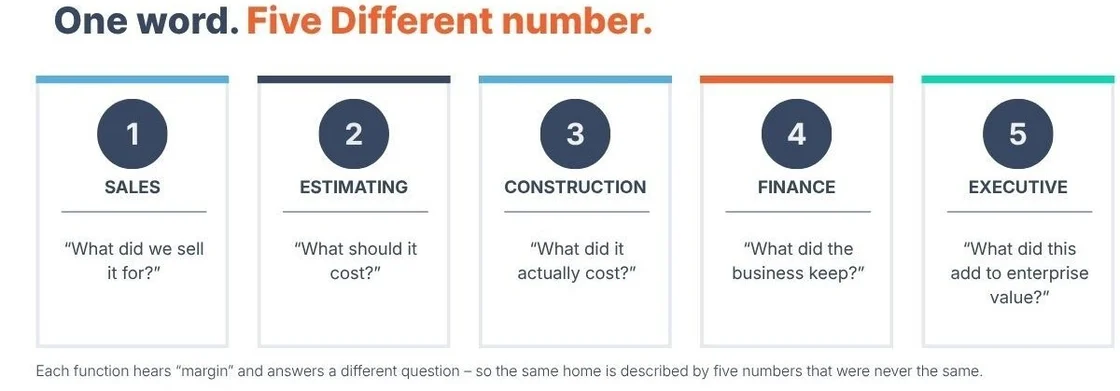
The real danger is not disagreement — it is the illusion of agreement. Two leaders can nod at “39% margin” while picturing entirely different economics. And the number does not only shift with who is speaking; it shifts with when you ask.
A margin without a definition is a rumour. Two people can agree on a number and still be describing entirely different businesses.
Why Timing Matters
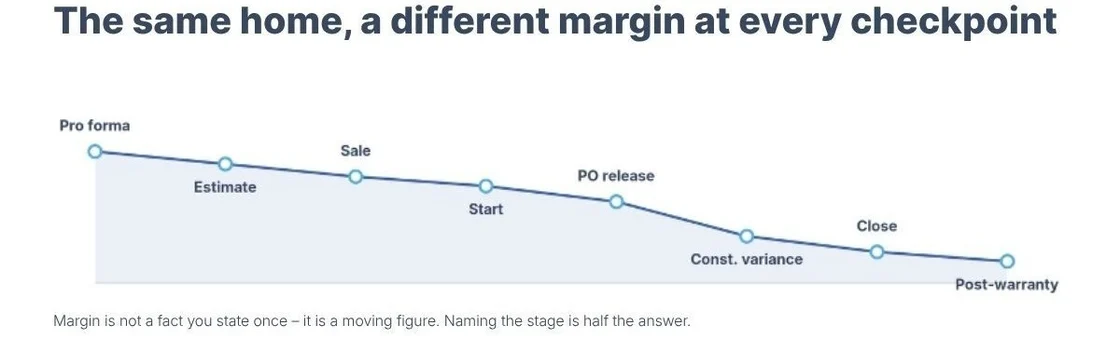
The same home carries a different margin number at contract, at framing, at closing, and after the post-close reconciliation. Each is accurate. None of them is the whole truth. Leaders who rely on a single snapshot are making decisions from a photograph of a river — they see where the water was, not where it is.
The Margin Stack: What Each Layer Actually Tells You
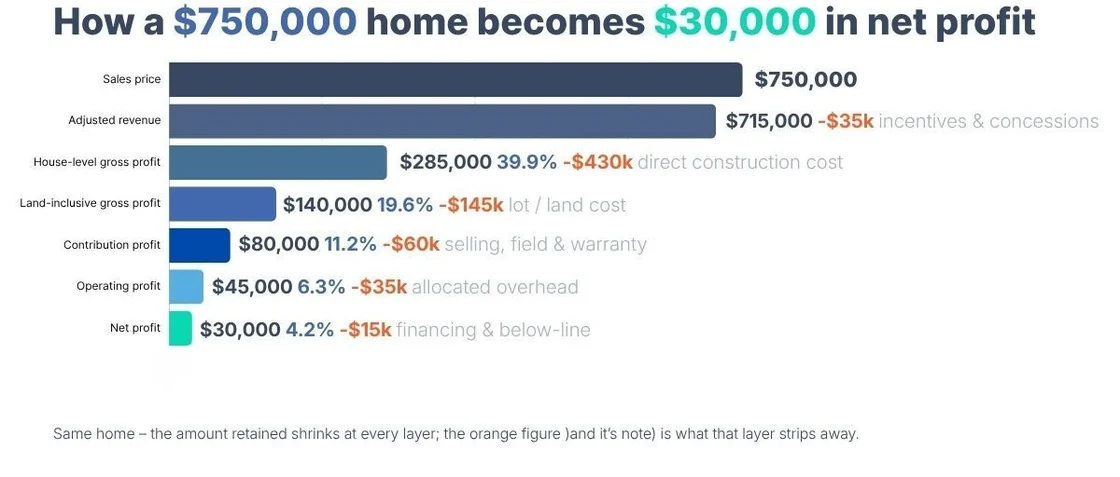
Margin was never one number. It is a stack of them. Each layer peels away a different cost — incentives, construction, land, selling, overhead, financing — and each tells a different, equally true story. Read top to bottom, the same $750,000 home is a 39.9% business and a 4.2% business at the same time.
Land margin: the layer most leaders underwatch
A home can look strong on construction margin and turn ordinary once lot economics are included. Manage one without the other and you are optimizing the wrong thing. Land is where the deal was made long before the first shovel hit the ground — and its cost rarely changes after acquisition.
Contribution margin: where operating truth surfaces
Contribution margin is the cleanest level for comparing communities, product lines, sales programs, and pricing — because it captures what a home actually contributes before corporate overhead clouds the view. It is the number your ops leaders should be held to first.
Related reading: How disconnected software quietly eats away at builder margins. When your construction data lives in one system and your financial data in another, even the best margin definition breaks down in execution.
How Leaders Reinforce Margin Discipline
Six habits separate teams that manage margin from teams that merely report it:
- Publish a margin glossary — one written definition per term, signed off by finance and ops together.
- Standardize reporting so every community rolls up the same way, every cycle.
- Show margin by stage, not as a single snapshot — contract, start, close, post-close.
- Ban single-number reporting — a margin without a definition is a rumour.
- Say the full name — “contribution margin,” not just “margin.”
- Tie incentives to the correct layer, so behaviour follows the real number.
The Executive Habit
Stop asking “What’s the margin?” Start asking: “What’s the margin at this stage, on which definition, and what has changed since the last decision point?”
The first question invites a confident, useless answer. The second makes the definition impossible to hide.
Newsletter
Read it a week before it lands here.
Every issue goes out to builders first. A day later it shows up on the blog.
No spam, unsubscribe anytime.